Cannabis Sugar Leaves: Anatomy, Identifying Healthy vs. Sick Foliage
Royal King Seeds
Cultivation team
Most Aussie growers obsessing over bud size are ignoring the one structure that tells them everything about plant health weeks before it shows up anywhere else — the sugar leaf. When a sugar leaf curls, yellows, or goes crispy during a Sydney summer or a humid Brisbane flowering week, that's not cosmetic damage. That's your plant sending a distress signal you've got a narrow window to act on.
Understanding sugar leaf anatomy and knowing exactly what healthy versus sick foliage looks like can mean the difference between a full harvest and a crop that collapses in the final fortnight. This guide maps every layer of sugar leaf biology, shows you how to read foliage like a diagnostic chart, and gives you the state-by-state context Aussie growers actually need.
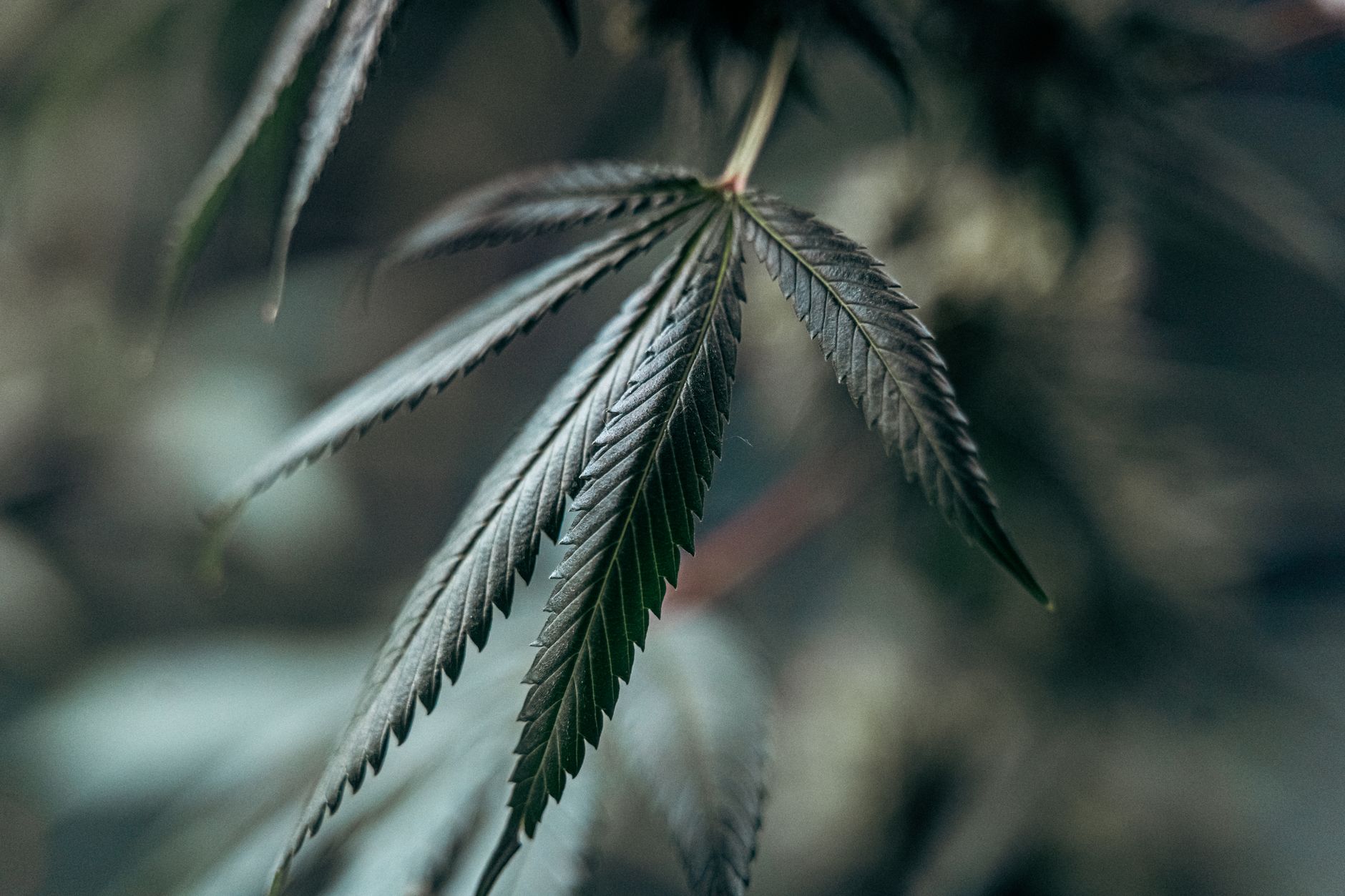
Sugar leaves are the small, single-bladed leaves that emerge directly from cannabis buds during the flowering stage. They're coated in trichomes — the resin glands that produce cannabinoids and terpenes — which give them a frosty, sugar-dusted appearance. Healthy sugar leaves are firm, deep green, and heavily frosted; sick leaves show yellowing (chlorosis), brown spots (necrosis), curling edges, or powdery coatings. Reading sugar leaf condition is the fastest way to diagnose nutrient, environment, or disease problems in a flowering plant.
- What Are Cannabis Sugar Leaves?
- Sugar Leaf Anatomy: What's Actually Inside
- What Do Healthy Sugar Leaves Look Like?
- How to Identify Sick Sugar Leaves: 8 Diagnostic Symptoms
- Sugar Leaves vs. Fan Leaves: Why the Difference Matters
- Australian Climate Stressors That Damage Sugar Leaves
- Sugar Leaf Stress Patterns by Australian State
- Week-by-Week Sugar Leaf Health Timeline
- Royal King Seeds Sugar Leaf Diagnostic Score
- Common Sugar Leaf Mistakes Aussie Growers Make
- What Happens If You Ignore Sugar Leaf Warning Signs?
- FAQ: Cannabis Sugar Leaves
- Sources
- ✓ First-time and intermediate Aussie growers wanting to understand plant health signals
- ✓ Outdoor growers in high-humidity states (QLD, NSW coastal, NT) battling foliage disease
- ✓ Indoor growers troubleshooting nutrient or environment problems mid-flower
- ✓ Anyone trimming harvest and wondering what to do with sugar leaves
- ✓ Growers in VIC/TAS managing cool-season stress on autoflowering seeds
- ✗ Growers looking for a yield-maximisation guide (see our grow guides)
- ✗ Readers looking for harvest trimming tutorials
- ✗ Jurisdictions where cannabis cultivation is not legally permitted
What Are Cannabis Sugar Leaves?
Sugar leaves are the small, resin-coated leaves that grow directly out of cannabis flower clusters (buds) during the flowering stage. They're structurally different from fan leaves — the large, fingered leaves most people picture when they think of cannabis.
The name "sugar leaf" comes from appearance: dense trichome coverage makes them look dusted with white sugar crystals. This frosting is composed of glandular trichomes — the same resin structures found on buds — making sugar leaves among the most cannabinoid-rich leaf tissue on the plant.
In Australia, where both feminised cannabis seeds and autoflowering varieties are grown across wildly different climates, sugar leaves function as the clearest real-time diagnostic panel the plant offers. They respond to environmental shifts and nutritional imbalances faster than buds, and they're always visible if you know what to look for.
Sugar leaves are not decorative. They are real-time health indicators. Any grower who dismisses foliage changes mid-flower as "normal senescence" risks missing a correctable problem. Monitor sugar leaf condition at least twice weekly during weeks 3–7 of flower.
Sugar Leaf Anatomy: What's Actually Inside?
Sugar leaves share the same fundamental plant architecture as fan leaves, but they're structurally optimised for different roles. Understanding each layer helps you diagnose damage accurately.
The Epidermis and Cuticle
The outermost layer of a sugar leaf is the epidermis, covered by a waxy cuticle. This cuticle prevents water loss and provides a first barrier against fungal spores and pest penetration. In healthy plants, the cuticle is glossy and intact. In heat-stressed plants — a real issue across inland WA and SA summers — the cuticle can crack and lose moisture faster than roots can replenish it.
Glandular Trichomes
The defining feature of a sugar leaf is its trichome density. Three types are present: bulbous (tiny, limited cannabinoid production), capitate-sessile (medium, moderate cannabinoid content), and capitate-stalked (large, full-spectrum cannabinoid and terpene synthesis).
Capitate-stalked trichomes on sugar leaves are visible to the naked eye as white crystalline hairs. Their colour signals maturity: clear = immature, milky white = peak THC, amber = degrading THC, rising CBN. This is why sugar leaf trichomes are used by experienced growers as a secondary harvest timing signal.
Mesophyll and Vascular Bundles
Below the epidermis lies the mesophyll — the photosynthetic tissue housing chlorophyll. Chlorophyll breakdown (chlorosis) is the first visual sign of nitrogen deficiency, pH lockout, or magnesium shortage. The midrib vein and lateral veins distribute water and dissolved nutrients. Interveinal chlorosis — yellowing between veins while veins stay green — is a classic magnesium or iron deficiency pattern.
Stomata
Sugar leaves have stomata on their undersides — microscopic pores that regulate gas exchange (CO₂ in, O₂ and water vapour out). During high humidity or pest infestation (particularly spider mites in hot, dry Aussie summers), stomata are the entry point for pathogen spread. Stomatal blockage from powdery mildew coatings reduces photosynthesis measurably within 48–72 hours of infection onset.
The trichome and stomatal layers of sugar leaves carry the most diagnostic weight. Trichome colour tells you where the plant is in its maturity arc; stomatal health tells you whether the environment is working for or against it. Check both during weekly inspections.
What Do Healthy Sugar Leaves Look Like?
Healthy sugar leaves have a specific, consistent profile. Anything that deviates is worth investigating.
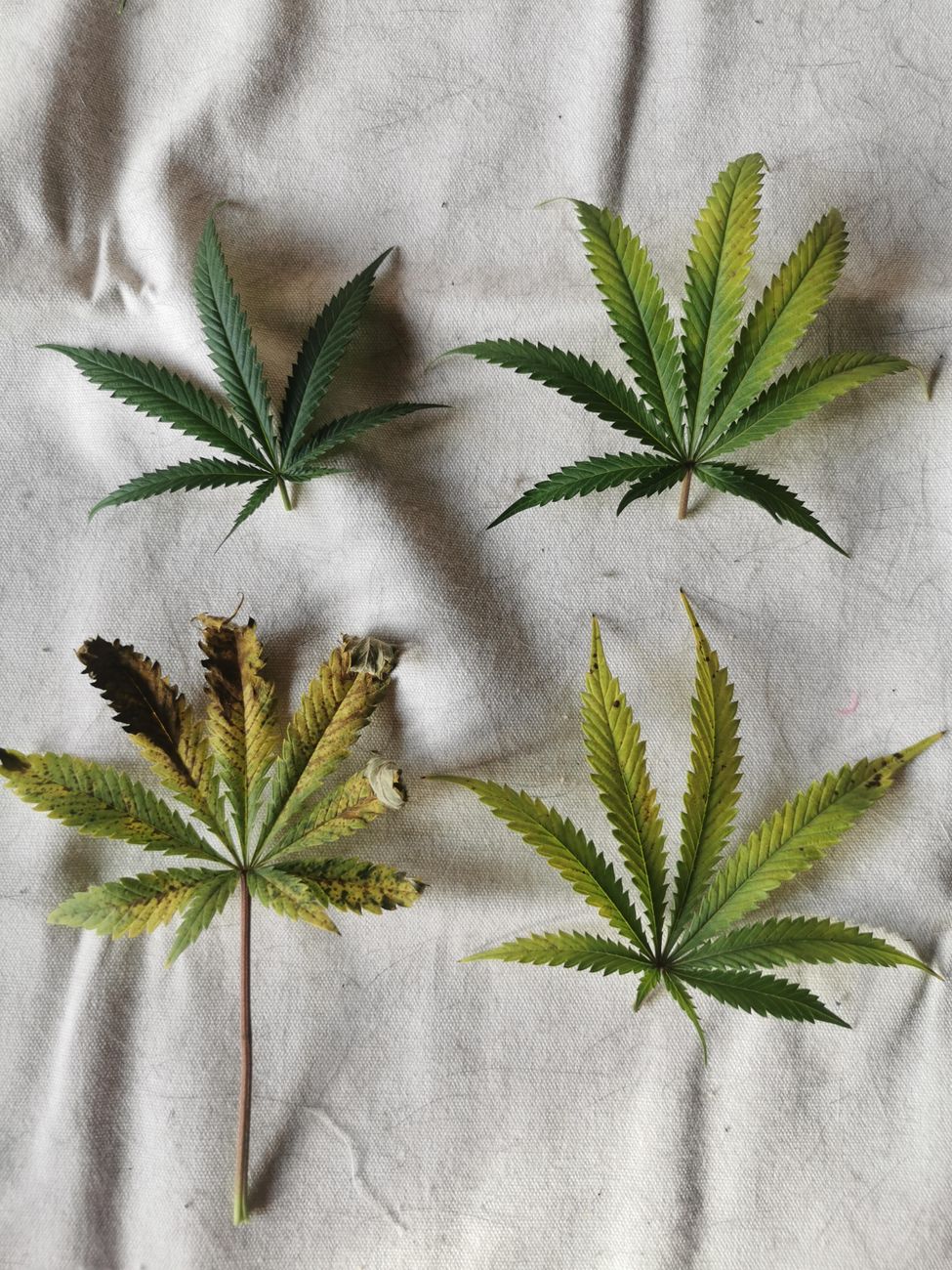
- Colour: Deep, saturated green — not pale, not yellow-green, not lime. Indica-dominant strains often show darker green; sativa-dominant may be slightly lighter.
- Trichome coating: Visibly dense, white-to-milky trichomes across the full leaf surface, especially the upper side. Frosting should be uniform, not patchy.
- Texture: Firm, slightly waxy to the touch. Not limp, not crunchy.
- Shape: Flat or very slightly cupped upward (a mild "canoe" shape is normal). Edges should not be clawing downward or curling upward dramatically.
- Size: 3–7 cm in length at peak flower development. Undersized sugar leaves can indicate stunted flower development.
- No marks: No spots, patches, streaks, webbing, or powdery coatings on a healthy leaf.
Looking at the questions our support team fields most often, one pattern emerges: growers confuse normal late-flower yellowing of lower fan leaves with sugar leaf chlorosis, and respond with incorrect feeding changes. The rule is simple — fan leaf yellowing in weeks 6–8 is expected nitrogen draw-down. Sugar leaf yellowing at any stage is a red flag.
If your sugar leaves are deep green with uniform trichome coverage and no physical deformities, your plant is performing well. The standard to aim for is consistent green all the way to week 7–8 of flower, with colour shifting only in the final week of ripening — never mid-cycle.
How to Identify Sick Sugar Leaves: 8 Diagnostic Symptoms
Each symptom pattern maps to a distinct root cause. The faster you match symptoms to causes, the faster you can correct.
Symptom 1: Overall Yellowing (Chlorosis)
What it looks like: Uniform pale yellow-green across the whole leaf, starting from the tips or base.
Likely causes: Nitrogen deficiency (most common), pH lockout (roots unable to absorb nutrients), overwatering causing root suffocation.
Action: Check runoff pH first (target 6.0–7.0 soil, 5.5–6.5 hydro). If pH is correct, increase nitrogen input at half-dose increments.
Symptom 2: Interveinal Chlorosis
What it looks like: Veins stay green while tissue between veins turns yellow or pale.
Likely causes: Magnesium deficiency (very common in Australian tap water with low Mg²⁺), iron deficiency (less common, usually pH-related).
Action: Flush with pH-correct water, then apply 1–2 g/L of Epsom salt (MgSO₄) as a foliar spray or root drench. Results visible within 5–7 days if Mg was the cause.
Symptom 3: Brown or Rust-Coloured Spots
What it looks like: Random or patterned brown, rust, or orange spots across the blade.
Likely causes: Calcium deficiency, potassium deficiency, fungal infection (septoria, botrytis early signs), or nutrient burn splash marks.
Action: Isolate and inspect the underside for fungal growth. Check calcium-magnesium ratios. Remove affected leaves to prevent spread.
Symptom 4: Downward Claw Curling (The "Claw")
What it looks like: Leaf tips curl downward and inward, resembling a claw. The leaf may feel firm.
Likely causes: Nitrogen toxicity (overfeeding), overwatering, or heat stress combined with high humidity — a common combo in subtropical QLD and NT during summer grows.
Action: Reduce nitrogen immediately, improve drainage, increase airflow. Clawing caused by overwatering resolves within 48 hours of correct watering frequency.
Symptom 5: Upward Leaf Cupping or Taco-ing
What it looks like: Leaf edges curl upward, creating a taco or canoe shape. Leaf appears dry or rigid.
Likely causes: Heat stress (most common in Perth and Adelaide summers above 38°C), underwatering, or light burn from LEDs or HPS positioned too close.
Action: Move light source further away (minimum 45 cm for 600W HPS, 30–40 cm for quality LEDs depending on manufacturer specs). Increase watering frequency in heat events.
Symptom 6: Powdery White Coating
What it looks like: White or grey powdery film on the upper leaf surface that doesn't wipe away cleanly without leaving a stain.
Likely causes: Powdery mildew (Podosphaera xanthii) — one of the most common cannabis pathogens in temperate Australian climates, particularly in Melbourne's spring humidity or Sydney's coastal nights.
Action: Increase airflow immediately. Apply potassium bicarbonate or a diluted hydrogen peroxide solution (3%, 1:9 ratio with water) as a foliar spray. Remove heavily infected leaves. Reduce humidity below 50% RH during lights-off.
Symptom 7: Tiny Yellow Stippling with Webbing
What it looks like: Tiny pale yellow dots across the blade (stippling), with fine webbing on the underside in advanced cases.
Likely causes: Spider mites (Tetranychus urticae) — particularly common in hot, dry inland Australian conditions (SA, WA, ACT summer).
Action: Inspect the underside with a jeweller's loupe. Treat with neem oil or spinosad-based spray early. In flower, use insecticidal soap to reduce residue on trichomes.
Symptom 8: Burnt, Crispy Tips
What it looks like: Leaf tips turn brown and crispy while the rest of the leaf remains green. Progresses inward if not corrected.
Likely causes: Nutrient burn (EC too high), potassium toxicity, or salt build-up in the root zone from over-fertilising without regular flushing.
Action: Flush with 3× the pot volume of pH-correct water. Reduce nutrient solution EC to 1.2–1.6 mS/cm for mid-flower. Do not remove tip-burnt leaves unless they're dead — partial green still photosynthesises.
The fastest diagnosis always starts at the bottom of the symptom list and works up: check pH and EC first, then check environment (temperature, humidity, airflow), then check for pests. Most sugar leaf problems in Australian grows trace back to pH drift or heat stress before anything else.
Sugar Leaves vs. Fan Leaves: Why the Difference Matters
Confusing sugar and fan leaf symptoms leads to incorrect corrections. Here's how they differ diagnostically:
| Feature | Sugar Leaves | Fan Leaves |
|---|---|---|
| Location | Emerge from bud sites | Emerge from main stem / branches |
| Trichome density | Very high (full cannabinoid profile) | Low to none |
| Size | 3–7 cm, single blade | 10–30 cm, multi-fingered |
| Yellowing late flower | Always a problem signal | Normal in weeks 6–8 (N drawdown) |
| Diagnostic priority | HIGH — problems here = bud health risk | MEDIUM — useful early, less critical late |
| Trimmed at harvest? | Usually yes (wet or dry trim) | Always removed |
| Usable material? | Yes — used in hash, extracts, edibles | Minimal cannabinoid content |
Treat sugar leaf health as a proxy for bud health. Because sugar leaves are physically embedded in the flower, any disease, deficiency, or environmental stress affecting sugar leaves is already affecting the bud itself. Fan leaf issues are early warnings; sugar leaf issues are active crises.
Australian Climate Stressors That Damage Sugar Leaves
Australia's climate diversity means sugar leaf stressors vary dramatically by region. Here's how major Australian climate zones impact foliage health during the critical flowering window (typically Jan–Mar for outdoor photoperiod grows).
Heat Stress — SA, WA, and Inland NSW/VIC
Temperatures above 32°C cause stomata to close, slowing photosynthesis and transpiration simultaneously. Above 38°C, enzyme activity in the mesophyll begins to break down, accelerating chlorophyll degradation. Perth and Adelaide growers regularly see 40°C+ days in January–February — peak flowering time for outdoor photoperiod strains. Heat-damaged sugar leaves taco upward, lose trichome density faster, and show interveinal browning within 3–5 days of sustained extreme heat without shade intervention.
Humidity and Mould — QLD, NT, and Coastal NSW
Powdery mildew and botrytis (grey mould) are the dominant sugar leaf threats in subtropical and tropical climates. Botrytis infects from the inside of the bud outward — by the time you see grey mould on a sugar leaf, bud rot is already in progress underneath. Reviewing public grower journals from QLD outdoor grows, mould complaints cluster almost exclusively in the March–April harvest window when overnight humidity spikes above 80% RH and canopy airflow is restricted. Dense indica genetics with tight bud structure are particularly vulnerable.
Cool-Stress — TAS and Alpine VIC
Below 15°C, nutrient uptake slows significantly — particularly phosphorus and magnesium — producing purple discolouration in sugar leaves that's often misread as a desirable aesthetic trait. In fact, cooler-than-optimal temps below 12°C during flower cause stress-induced anthocyanin production (the purple pigment), which can mask underlying deficiency symptoms. Autoflowering seeds with cold-tolerant genetics handle this better than many photoperiod sativas.
In Australia, the single most destructive sugar leaf threat is climate-driven humidity stress during the March–April outdoor finish window. Manage canopy density, invest in weather monitoring, and choose mould-resistant genetics for any coastal or subtropical outdoor grow. Check the Bureau of Meteorology climate data for your postcode before choosing your strain and start date.
Sugar Leaf Stress Patterns by Australian State
QLD — Subtropical Humidity
The dominant sugar leaf threat in QLD is powdery mildew and botrytis during the autumn harvest window. Prioritise open-structured sativa-leaning genetics with high mould resistance. Maintain humidity below 50% during the final three weeks of flower with oscillating fans and defoliation of interior bud sites. Browse sativa cannabis seeds suited to warm, humid climates.
NSW — Temperate Coast + Humid Inland
Coastal NSW experiences mild daytime heat with humid nights — ideal conditions for powdery mildew in September–November (spring vegetation) and botrytis in March–April (outdoor finish). Inland NSW can experience 40°C+ summer days causing heat taco and trichome degradation. A balanced genetics approach works best — moderate heat tolerance with solid mould resistance.
VIC — Temperate with Unpredictable Swings
Melbourne's "four seasons in one day" pattern creates abrupt temperature swings that stress sugar leaves differently within hours. The most common Victoria sugar leaf complaint from public grower forums: phosphorus deficiency symptoms (purple-tinged, slow-to-develop buds) caused by cold nights dropping below 14°C in March. Plan early — start photoperiod grows by mid-October at latest to clear March before cold sets in.
WA — Mediterranean Heat and Aridity
Perth growers face a unique challenge: very low humidity (good for mould resistance) combined with extreme daytime heat (40°C+ January-February) and drying winds. Sugar leaves in WA grows commonly show taco curling and rapid trichome maturation (amber transition faster than expected) under heat stress. Shade cloth at 30% density during peak summer afternoons significantly reduces sugar leaf damage based on aggregated WA grower reports.
SA — Hot, Dry Mediterranean
Adelaide's Mediterranean climate produces the same heat-stress sugar leaf profile as WA. Magnesium deficiency is frequently reported in SA tap water areas — expect to supplement with Epsom salt through the full flowering period. Indoor high THC seed varieties grown with climate control perform reliably year-round in SA.
TAS — Cool-Temperate with Short Windows
Tasmania's short outdoor window (Nov–Feb is the safe flowering zone; Mar brings early frost risk in elevated areas) means sugar leaf phosphorus and magnesium uptake is frequently compromised by cold nights. Trichome development is slower in cool temps. Autoflowers with 60–75 day total cycles are the recommended choice — they finish before the cool-temperate April onset, and their sugar leaf production keeps pace even in lower light hours.
NT — Tropical Stress Year-Round
Darwin and Top End growers face 85–95% RH during the wet season (November–April). Sugar leaf mould risk is extremely high; even mould-resistant genetics require rigorous canopy management. Dry season (May–October) grows are significantly more manageable for foliage health. Thin-leafed, open-structured genetics reduce stagnant air pockets between bud sites.
Week-by-Week Sugar Leaf Health Timeline
This colour-coded timeline is for a standard 8-week photoperiod flower. Autoflowers follow a compressed version (weeks 1–2 = veg overlap, weeks 3–7 = active flower). Use this as your inspection checklist each week.
Early Flower
Sugar leaves just emerging. Should be bright green, no frosting yet. Watch for any existing deficiency carrying in from veg.
Trichome Build
Trichomes becoming visible. Sugar leaves should be deep green and firm. Any yellowing at this stage = active problem to fix immediately.
Peak Resin
Maximum trichome density. Leaves may show minor tip browning if EC has been high — acceptable. Watch closely for powdery mildew and mites.
Late Flower
Some natural yellowing of lower sugar leaves is acceptable. Upper canopy leaves should still be green. Trichomes transitioning milky → amber.
Final Ripening
Sugar leaves begin natural die-back as plant draws nutrients toward final bud swell. This is normal. Any new spots or mould = address immediately — you have 5–7 days.
Amber Threshold
Use a jeweller's loupe (30–60×) or digital microscope. Harvest when 10–30% amber trichomes on sugar leaves for balanced head/body effect; 30%+ amber for sedative effect.
Weeks 3–5 are the highest-risk period for sugar leaf problems — trichome production is highest, metabolic demand is highest, and any nutrient or environmental issue will visibly manifest fastest. Make this your inspection-intensive window.
Royal King Seeds Sugar Leaf Diagnostic Score
Use this scoring rubric to rate your plant's foliage health in under 5 minutes. Assess once per week during flower. Score each axis out of 20; maximum total is 100.
A weekly 5-axis assessment scoring the real-time health of cannabis sugar leaf foliage. Total score = 100. Score at week 4 of flower for a mid-cycle baseline.
Formula: Colour (20) + Trichome uniformity (20) + Texture/structure (20) + Freedom from symptoms (20) + Trichome maturity alignment (20) = RKS Score
Example (week 4 of healthy indica): Deep green (19) + Uniform frost (18) + Firm, flat (20) + No spots or curl (20) + Trichomes milky (18) = RKS Score: 95/100 → Excellent
Benchmark: 85–100 = Excellent | 70–84 = Good (monitor) | 55–69 = Caution (investigate) | Below 55 = Intervene within 24–48 hours
| Issue Present | Colour Score Impact | Symptom Score Impact | Likely Cause | Priority | Fix Timeline |
|---|---|---|---|---|---|
| Uniform yellowing | −10 to −15 | −10 | N deficiency / pH lockout | HIGH | 48–72 hrs |
| Interveinal chlorosis | −8 | −8 | Mg or Fe deficiency | HIGH | 5–7 days with Epsom |
| Brown rust spots | −5 to −10 | −10 to −15 | Ca deficiency / fungal | HIGH | Remove + treat within 24 hrs |
| Downward claw curl | −3 | −8 | N toxicity / overwatering | MEDIUM | 48 hrs |
| Upward taco curl | −4 | −8 | Heat stress / light burn | HIGH | Same day |
| Powdery coating | −5 | −15 to −20 | Powdery mildew | CRITICAL | Treat within 12 hrs |
| Stippling + webbing | −5 | −15 | Spider mites | CRITICAL | Treat within 12 hrs |
Why the top 3 threats score highest:
- Powdery mildew (CRITICAL): Spreads to the entire bud within 72 hours, renders the harvest unusable, and is nearly impossible to fully eliminate once established in late flower.
- Spider mites (CRITICAL): Reproduce in 3–5 days in warm Australian conditions; a small colony becomes a full infestation within two weeks. Trichome damage is irreversible.
- Uniform yellowing (HIGH): Signals systemic nutrient failure affecting all photosynthetic tissue, directly reducing carbohydrate supply to developing buds.
Common Sugar Leaf Mistakes Aussie Growers Make
Mistake 1: Stripping All Sugar Leaves During Defoliation
What happens: Over-aggressive mid-flower defoliation removes sugar leaves attached to developing bud sites, directly reducing the photosynthetic and trichome-producing tissue around the bud. Yield drops by an estimated 10–20% based on aggregated grower-reported comparisons.
How to fix: Defoliate fan leaves only. Leave sugar leaves intact unless they're already dead, diseased, or blocking light to a lower bud site.
Mistake 2: Ignoring Trichome Colour on Sugar Leaves vs. Calyx Trichomes
What happens: Sugar leaf trichomes mature faster than calyx (bud) trichomes by approximately 1–2 weeks. Growers using only sugar leaf trichomes to time harvest end up cutting 7–14 days early.
How to fix: Use calyx trichomes as your primary harvest signal. Sugar leaf amber trichomes are a secondary indicator — useful for confirming you're in the late window, not for setting the exact day.
Mistake 3: Treating Fan Leaf Yellowing and Sugar Leaf Yellowing the Same Way
What happens: Growers who don't differentiate these two leaf types increase nitrogen feeding when they see any yellowing, causing nitrogen toxicity (claw) in sugar leaves while they're already in a natural fan leaf senescence cycle.
How to fix: If yellowing is on fan leaves in week 6+, reduce nitrogen slightly — it's normal. If yellowing is on sugar leaves at any stage, check pH and Mg first before adjusting nutrients.
Mistake 4: Not Inspecting Sugar Leaf Undersides
What happens: Spider mites, russet mites, and early botrytis infection all begin on the underside of leaves. By the time damage is visible on the upper surface, the infestation is already advanced.
How to fix: During twice-weekly inspections, physically tilt a sugar leaf and inspect the underside with a magnifier. Look for stippling, tiny moving dots, or grey fuzzy growth at the base of the leaf.
Mistake 5: Foliar Spraying in Flower
What happens: Spraying any liquid directly onto developing buds and sugar leaves during week 3+ of flower creates moisture pockets that accelerate botrytis. Water droplets on trichomes under HPS or intense LED also cause heat spotting.
How to fix: Limit foliar treatments to the vegetative stage. If a flowering-stage pest or mildew emergency requires spraying, treat at lights-off, use a fine mist only on affected areas, and ensure fans are running to dry leaves within 30 minutes.
Mistake 6: Dismissing Purple Sugar Leaves as "Desirable" Without Checking Temperature
What happens: Purple anthocyanin discolouration in sugar leaves during cool Tasmanian or Victorian nights is often shared on forums as an aesthetic feature. In cold-stressed plants, it frequently co-occurs with phosphorus uptake blockage that reduces bud density.
How to fix: If temps consistently drop below 14°C, check for phosphorus deficiency symptoms alongside the purple colouration. Use a bloom booster with chelated phosphorus and ensure root zone temperature stays above 18°C if possible.
The most costly mistake is timing — specifically treating problems too late. Every symptom above has a 48–72 hour window where correction is fully effective. Beyond that, you're managing damage, not reversing it. Set calendar reminders for twice-weekly sugar leaf inspections from week 3 of flower.
What Happens If You Ignore Sugar Leaf Warning Signs?
Two scenarios — one proactive grower, one who waits — same strain, same environment, same start date. The only difference is how they responded to early sugar leaf symptoms.
- Strain: Feminised indica hybrid, outdoor NSW
- Week 4 symptom: Interveinal chlorosis noticed on 3 sugar leaves
- Response: pH checked (6.8 — slightly high), flushed, Epsom salt drench applied
- Week 5: New sugar leaf growth deep green, chlorosis halted
- Harvest: Week 9, 145 g/plant dry weight, trichomes intact
- Risk level: Low
- Outcome: Full harvest, no yield loss from deficiency
- Strain: Same feminised indica hybrid, same location
- Week 4 symptom: Same interveinal chlorosis — treated as "normal senescence"
- Week 5: Chlorosis spread to 60% of sugar leaves; powdery mildew appears (humidity-driven)
- Week 6: Mildew spreads to bud exterior; early harvest forced at 70% trichome maturity
- Harvest: Week 7 (forced), 72 g/plant dry weight, 30% of material discarded
- Risk level: Critical
- Outcome: ~50% yield loss, inferior quality, wasted season
Bottom line: A single 10-minute sugar leaf inspection at week 4 — and the correct response to what was found — produced over double the harvestable material from the same plant genetics. Sugar leaves don't lie; ignoring them costs you the season.
Every correctable sugar leaf symptom has a 48-hour window of maximum effectiveness. Acting within this window corrects the problem; acting after it manages ongoing damage. Formula: Symptom observed → Same-day diagnosis (pH + EC + visual inspection) → Correction applied within 48 hours = symptom halted. Delay beyond 96 hours = 70%+ chance of irreversible damage or secondary infection (based on aggregated public grow journal data from Australian community forums).
Rule: When in doubt, act first, adjust second. A conservative correction (flush + Epsom) costs you nothing. Waiting costs you the crop.
Shop Feminised Cannabis Seeds Australia →
FAQ: Cannabis Sugar Leaves
What is a sugar leaf on a cannabis plant?
Are sugar leaves worth keeping after harvest?
Why are my sugar leaves yellowing during flowering?
Should I remove yellowing sugar leaves?
Can I use sugar leaf trichomes to time harvest?
Why are my sugar leaves curling upward like tacos?
What's the white powdery stuff on my sugar leaves?
How do I tell the difference between mite damage and nutrient deficiency on sugar leaves?
Can I start growing outdoors in November in QLD and still get healthy sugar leaves?
Why did my sugar leaves turn purple in my VIC outdoor grow?
Do autoflowers produce sugar leaves the same way photoperiod strains do?
Why did my sugar leaves develop crispy brown tips even though I didn't overfeed?
Should I defoliate sugar leaves to improve airflow and reduce mould risk?
How do I tell if sugar leaf damage is reversible or permanent?
My sugar leaves went from green to yellow in under 48 hours — what caused it?
Can I foliar spray sugar leaves in late flower to treat mildew?
How many times should I check my sugar leaves during flowering?
Why are my sugar leaves much smaller than expected?
Is it normal for sugar leaves to die back in the final week of flower?
Which Australian states have the highest sugar leaf mould risk outdoors?
What's the difference between healthy sugar leaf trichomes and a calcium or mineral deposit?
Can sugar leaves be used in tea or edibles?
Browse All Cannabis Seeds Available in Australia →
Sources
- Bureau of Meteorology — Australian Climate Data
- ABARES — Australian Bureau of Agricultural and Resource Economics
- Therapeutic Goods Administration (TGA) — Medicinal Cannabis Regulation
- Australian Department of Health and Aged Care
- NIH PubMed — Cannabis Trichome and Cannabinoid Research
- Australian Drug Foundation — Cannabis Information
- Frontiers in Plant Science — Cannabis Physiology Research
Ready to Start Growing?
Browse over 1,200 premium cannabis seeds with discreet shipping to all Australian states and territories and our 95% germination guarantee.
Shop Cannabis Seeds