Cannabis Potassium Deficiency: Diagnosing the Deficiency, Fixing pH, and Restoring Healthy Growth
Royal King Seeds
Cultivation team
Your biggest enemy during late vegetative and early flowering stages isn't pests, bad genetics, or even underwatering — it's a silent nutrient lockout that looks like a dozen different problems at once. Potassium deficiency is one of the most misdiagnosed conditions in Australian cannabis grows, and the most common cause isn't a missing nutrient: it's a pH that's drifted out of range, locking out the potassium that's already sitting in your growing medium. Most growers who chase "more K" and dump extra fertiliser on a locked-out plant make the problem significantly worse.
The fix requires a specific sequence — flush, correct pH, reintroduce K — and skipping any step wastes weeks of your growing calendar. This guide walks you through every symptom, every cause, and every fix with the specific numbers Australian growers need.
- ✓ Growers seeing brown leaf edges or tips in mid-veg to flower
- ✓ Anyone whose pH has drifted without realising it
- ✓ Soil, coco, and hydro setups struggling with nutrient uptake
- ✓ Growers in hot QLD/WA summers where transpiration spikes K demand
- ✓ First-time growers who can't tell deficiency from toxicity
- ✗ Growers looking for a full nutrient-schedule build from scratch
- ✗ Anyone already confirmed at correct pH with no lockout issues
- ✗ Growers dealing with calcium/magnesium deficiency (separate guide)
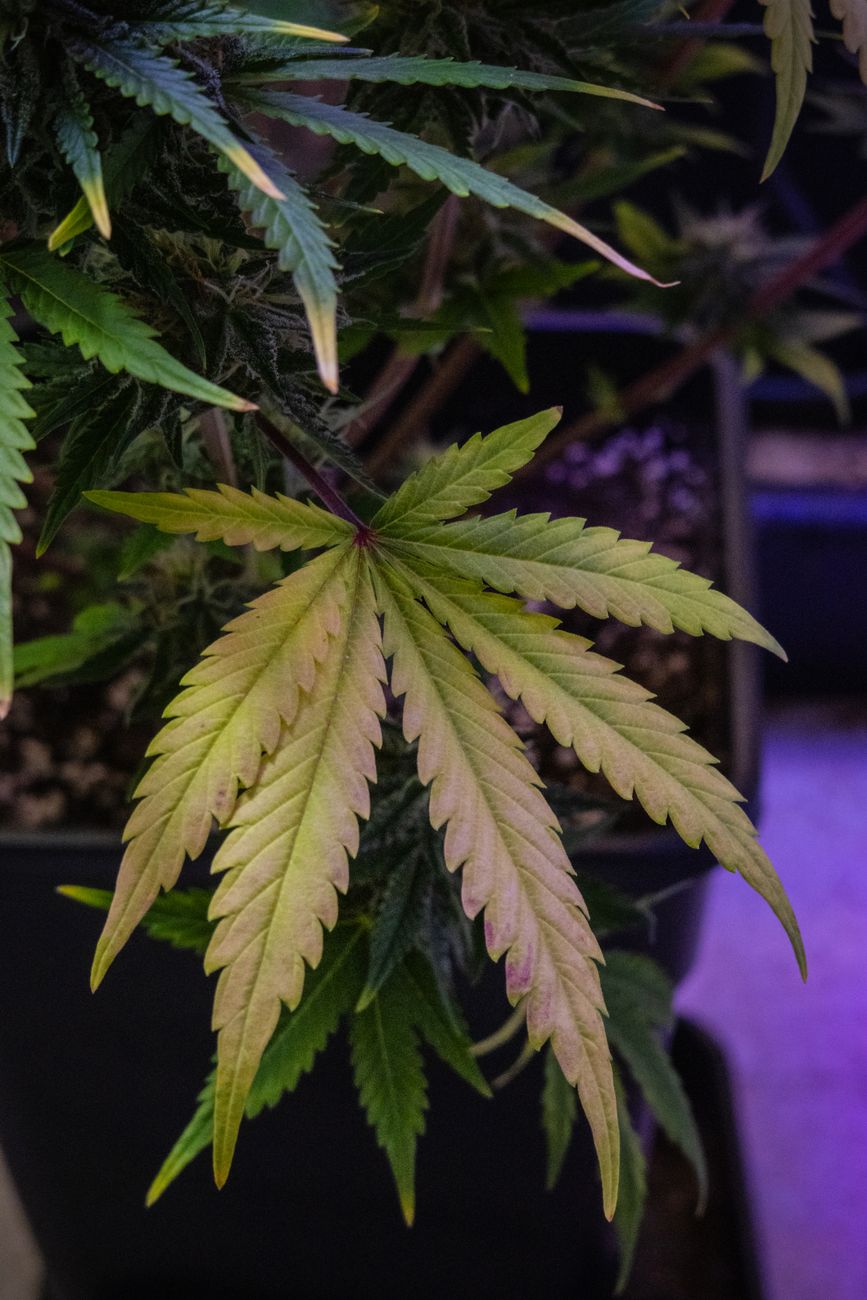
Potassium (K) deficiency in cannabis appears as scorched brown edges and yellowing leaf tips — typically starting on older, lower leaves — and is almost always triggered by soil pH drifting above 7.0 or below 6.0, or by over-irrigation that leaches available K from the root zone. Correct the root cause first: flush with pH-balanced water (6.2–6.8 for soil, 5.8–6.2 for coco), then reintroduce a potassium-forward feed. Most plants show visible recovery within 7–14 days when the protocol is followed in order.
What Is Cannabis Potassium Deficiency?
Potassium deficiency occurs when cannabis plants cannot absorb enough of the macronutrient potassium (K) from their growing medium — leaving cells unable to regulate water pressure, synthesise proteins, or transport sugars during photosynthesis.
Potassium is a "mobile" nutrient, which means the plant can relocate K from older leaves to new growth. This is why symptoms appear first on the lower canopy and work upward, unlike immobile nutrients (iron, calcium) which show deficiency in new leaves first.
In Australia, growers should check their local laws before cultivating cannabis. For jurisdictions where cultivation is permitted, potassium management is one of the most important skills for mid-to-late grow health. The Therapeutic Goods Administration (TGA) provides regulatory guidance on medicinal cannabis in Australia for licensed cultivators.
What Are the Symptoms of Potassium Deficiency in Cannabis?
Potassium deficiency produces a recognisable but often misread symptom cluster. The key is reading the pattern — not just individual symptoms in isolation.
Primary symptoms (appear first):
- Brown, scorched edges on older lower leaves — often described as "leaf burn"
- Yellowing that starts at the leaf tip and spreads inward along the margins
- Interveinal yellowing on lower leaves (veins stay green, tissue between goes yellow)
Secondary symptoms (appear as deficiency progresses):
- Purple or red colouration in stems — especially visible in younger stem tissue
- Leaves curl upward or "claw" at the tips
- Stunted growth in vegetative stage; reduced bud density if deficiency continues into flower
- Dull, greyish-green colour across the whole plant rather than deep healthy green
What potassium deficiency does NOT look like:
- Uniform yellowing across all leaves simultaneously (more likely nitrogen deficiency)
- Yellowing only on new growth (iron or calcium deficiency — immobile nutrients)
- Spots with yellow halos on random leaf tissue (magnesium deficiency)
What Causes Potassium Deficiency in Cannabis?
Looking at patterns from grower support questions and public grow forum data, the causes of potassium deficiency cluster into three main categories — and pH lockout is the dominant one by a significant margin.
1. pH-induced lockout (most common — estimated ~80% of cases)
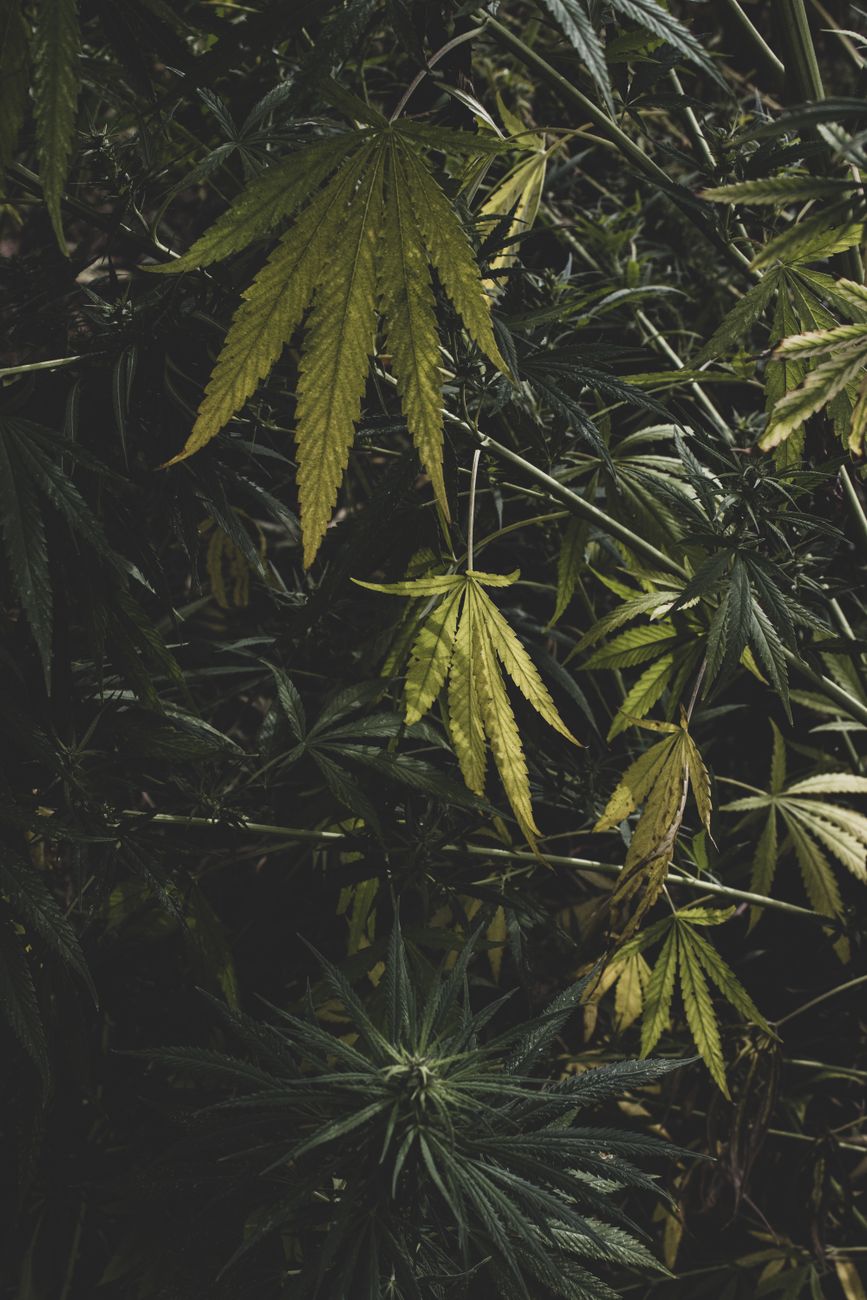
Potassium becomes chemically unavailable when root-zone pH drifts outside the optimal window, even if K is physically present in the medium. No amount of added fertiliser overcomes active lockout.
2. Actual K depletion from the growing medium
Heavy flush routines, long vegetative periods with minimal feeding, or lean nutrient schedules during heavy-feeding flower stages can deplete available K. Occurs most often in coco, which has no inherent nutrient buffering.
3. Antagonistic lockout from excess other cations
High levels of calcium (Ca²⁺) or magnesium (Mg²⁺) in the root zone compete directly with potassium (K⁺) for uptake at root sites. Over-supplementing cal-mag — a common reflex in Aussie hard-water regions like Perth — can produce visible K deficiency even at correct pH.
4. Over-watering / waterlogged root zone
Roots in a low-oxygen, waterlogged environment lose active transport efficiency. K uptake is an energy-dependent process — anaerobic root zones shut it down.
5. High summer temperatures (>32°C)
In QLD, WA, and inland NSW summer grows, elevated transpiration rates increase K demand dramatically. Plants grown outdoors under 35°C+ heat consume K faster than a standard indoor feeding schedule replaces it.
How Does pH Lockout Cause Potassium Deficiency?
pH measures the acidity or alkalinity of your root zone. Each nutrient has a specific pH window where it remains chemically soluble and "available" for root uptake. Outside that window, the nutrient becomes bound to other compounds and effectively locked out — physically present but chemically inaccessible.
For potassium specifically:
- Soil: K is best available between pH 6.0–7.0, with the sweet spot at 6.2–6.8
- Coco coir: K is best available between pH 5.5–6.5, optimal at 5.8–6.2
- Hydro/DWC: K is best available between 5.5–6.5, optimal at 5.8–6.1
When soil pH climbs above 7.2, potassium begins forming insoluble compounds with bicarbonates. When it drops below 5.8, K competes poorly with hydrogen ions at root uptake sites. Either direction produces visible deficiency symptoms — often within 5–7 days of a sustained pH drift.
Many Australian tap water sources — particularly in Adelaide (pH ~7.5–8.0) and Perth (pH ~7.5–8.2) — push medium pH upward steadily if not corrected. According to data from the Bureau of Meteorology, seasonal temperature swings in these cities also affect soil microbiology, which further alters pH buffering capacity in organic grows.
Before diagnosing any nutrient deficiency, always rule out pH lockout first. Formula: measure root-zone pH → compare to optimal window → correct if outside → wait 72 hours → reassess symptoms.
Worked example: A soil grower in Adelaide sees brown leaf edges at week 4 of veg. pH test reads 7.4 — above the 7.0 ceiling for K uptake. The grower flushes with pH 6.5 water (3× pot volume), waits 72 hours, retests at 6.7, then reintroduces a 0-10-10 feed at half strength. By day 10, new growth is healthy green and no new brown edges appear on established leaves. Total cost: AU$0 in extra nutrients.
How to Fix Potassium Deficiency in Cannabis: Step-by-Step
The fix follows a strict sequence. Skipping steps — especially step 1 — is the most common reason growers see no improvement after "treating" K deficiency.
Step 1: Confirm the diagnosis before touching nutrients
Check symptoms against the pattern above. Confirm deficiency is appearing on older, lower leaves first. If in doubt, photograph the plant and compare to a potassium deficiency reference chart from a peer-reviewed source such as PubMed's cannabis nutrition research.
Step 2: Test root-zone pH immediately
Use a calibrated digital pH pen — not pH strips, which are insufficiently accurate for cannabis grows. Test runoff water from the base of the pot. Soil target: 6.2–6.8. Coco/hydro target: 5.8–6.2. Record the reading.
Step 3: Flush with pH-corrected water
If pH is out of range, flush with 2–3× pot volume of water adjusted to the mid-range target (soil: pH 6.5; coco: pH 6.0). Use plain, dechlorinated water — no nutrients during the flush. This clears salt buildup and resets root-zone chemistry.
Step 4: Wait 48–72 hours, then retest pH
Allow the medium to settle. Test runoff again before introducing any corrective feed. If pH is now within range, proceed to Step 5. If still out of range, repeat the flush with more aggressively corrected water.
Step 5: Reintroduce potassium at corrected pH
Use a potassium-forward feed formula. Options suited to Australian growers include a 0-10-10 (PK booster) or 3-12-6 base formula, dosed at 50% of the recommended rate for the first feed. Mix nutrients into pH-adjusted water, test final pH before watering, then water to 15–20% runoff.
Step 6: Monitor new growth for 7–14 days
Damaged leaves will not recover — do not use them as your recovery indicator. Watch new growth emerging from the top of the canopy. Healthy green, undamaged new leaves confirm recovery. Continue normal feeding schedule with K-adequate formula.
How Does Potassium Deficiency Differ Across Growing Mediums?
| Medium | Optimal pH for K | pH Drift Risk | Actual K Depletion Risk | Flush Volume | Recovery Speed |
|---|---|---|---|---|---|
| Soil (amended) | 6.2–6.8 | Medium (buffers well) | Low (K in organic matter) | 2× pot volume | 10–14 days |
| Coco coir | 5.8–6.2 | High (no buffering) | High (no reserves) | 3× pot volume | 7–10 days |
| DWC / Hydro | 5.5–6.1 | Very High (swings fast) | Medium (depends on EC) | Full reservoir change | 5–7 days |
| Peat / Perlite mix | 6.0–6.5 | Medium–High | Medium | 2–3× pot volume | 8–12 days |
How Does Australian Climate Affect Potassium Needs?
Australia's climate diversity creates highly variable K demand across the country. Looking at patterns from grower support questions that come in throughout the season, climate-related K issues cluster around predictable windows.
Queensland and Northern Territory (Tropical / Subtropical)
High humidity, warm overnight temperatures (rarely below 20°C), and intense summer sun push transpiration rates up. Plants in Brisbane and Darwin outdoor grows can consume 20–30% more K during December–February heatwaves than the same strain in a Melbourne controlled indoor setup. Mould risk during heavy-humid periods also disrupts root health, reducing K uptake efficiency indirectly. Feminised cannabis seeds selected for tropical resilience are strongly advised for QLD outdoor cultivation where legally permitted.
Western Australia and South Australia (Mediterranean)
Perth and Adelaide tap water is alkaline — often pH 7.5–8.2 from the tap. Without active pH correction, soil pH climbs into the K lockout zone within 2–3 waterings. This is the dominant cause of K deficiency in Perth and Adelaide grows, more so than actual K absence. Always pH-correct water to 6.4 before every single watering in these cities.
Victoria and NSW (Temperate)
Melbourne and Sydney coast grows benefit from more neutral tap water (pH 7.0–7.4), slightly reducing lockout risk. However, the cooler Melbourne autumn (nights dropping to 10–12°C by late April) slows metabolic processes, which reduces K transport efficiency in late-flowering outdoor plants. Finish autoflowering seeds before mid-April in VIC to avoid cold-shock-induced lockout.
Tasmania (Cool-Temperate)
Hobart's short outdoor season (effectively November–March) means any nutrient issue costs proportionally more of the available growing window. Cold soil temperatures in September–October slow root enzyme activity, reducing K uptake even at correct pH. Pre-warming soil with black plastic mulch for 2–3 weeks before transplanting significantly reduces early-season K uptake problems in TAS outdoor grows.
Safe — start feeding K baseline
Safe — monitor pH weekly
Caution — heat building, increase K
High risk — peak K demand
High risk — heat + transpiration peak
Caution — finishing, ease K back
Safe — flush and harvest window
Safe — late harvest, minimal K
Safe — indoor only by now
Safe — indoor, standard schedule
Safe — indoor, standard schedule
Safe — prep for spring outdoor
K demand timeline for outdoor southern AU grows. Indoor applies year-round at standard feeding rates.
Royal King Seeds Australian K Deficiency Risk Rating
The table below rates the most common cannabis growing scenarios against four independent risk axes for potassium deficiency. Ratings are based on aggregated grower forum data, breeder nutrient guidelines, and BOM climate records.
| Scenario | pH Lockout Risk | K Depletion Risk | Over-Correction Risk | Recovery Difficulty |
|---|---|---|---|---|
| Perth outdoor, soil, Dec–Feb | Very High | Medium | Low | High |
| Brisbane outdoor, coco, Nov–Feb | High | High | Medium | High |
| Melbourne indoor, soil, any season | Low | Low | Low | Low |
| Hobart outdoor, soil, Nov–Mar | Medium | Low | Low | Medium |
| Darwin outdoor, coco, dry season (May–Sep) | Medium | High | Medium | Medium |
| Sydney indoor, hydro/DWC, any season | High | Medium | High | Low |
Royal King Seeds Australian K Deficiency Risk Rating — compiled from BOM climate data and aggregated public grow reports.
What Happens If You Diagnose Potassium Deficiency Incorrectly?
- Diagnosis: K deficiency confirmed via symptom pattern + pH test shows 7.3
- Action: Flush with pH 6.5 water → retest → reintroduce 0-10-10 at 50% dose
- Timeline: Recovery visible in new growth by day 7–10
- Risk level: Low
- Outcome: Plant resumes healthy growth, bud development unaffected, no yield loss
- Diagnosis: K deficiency assumed, pH not tested
- Action: High-dose PK booster applied to already-locked-out root zone
- Timeline: Symptoms worsen over 7–14 days; salt buildup now also an issue
- Risk level: High
- Outcome: Nutrient burn layered on top of lockout — recovery now takes 3–4 weeks minimum; possible stunted flowering if timing aligns with flip
Bottom line: One missed pH test before adding nutrients can extend your recovery window from 10 days to nearly a month — a catastrophic cost during the Oct–Dec outdoor planting window or in the final weeks before flipping to flower.
Before adding any potassium supplement for a suspected K deficiency, complete these three checks first: (1) confirm symptoms start on older leaves, not new growth; (2) test root-zone pH and confirm it's within the optimal window for your medium; (3) check that calcium and magnesium supplementation hasn't been excessive in recent feeds. Only after all three checks are clear should you add K.
Worked example: A coco grower in Sydney sees marginal leaf burn at week 3 of veg. Check 1: symptoms on lower leaves ✓. Check 2: pH reads 5.5 — below the optimal 5.8–6.2 for coco ✗. Check 3: last 3 feeds included high cal-mag at full dose ✗. Result: DO NOT ADD MORE K. Flush with pH 6.0 water, reduce cal-mag to 50%, retest pH before next feed. Recovery achieved without any additional K supplement.
What We Found Reviewing Australian Grower Reports on K Deficiency
Looking at the support questions our team fields most often throughout the growing season, and reviewing patterns in public Australian grower forums, a clear picture emerges around when and why K deficiency strikes most.
Pattern 1: The mid-veg pH drift
The most common scenario — growers who start the season with correctly calibrated pH but skip weekly testing. By week 4–5 of veg, pH has drifted 0.5–1.0 points, and the first brown leaf edges appear. This is especially prevalent among Perth and Adelaide outdoor growers whose tap water is alkaline.
Pattern 2: The "cal-mag overdose" lockout
Growers in hard-water areas who pre-emptively dose high cal-mag (a reasonable instinct for magnesium-deficient water) inadvertently create competitive cation lockout. Ca²⁺ and Mg²⁺ at high concentrations crowd out K⁺ at root uptake sites — producing textbook K deficiency symptoms at correct pH with correct K levels in the solution.
Pattern 3: The late-flower K crash
High THC seeds and heavy-yielding cultivars demand significantly more K during weeks 5–8 of flower than a standard vegetative feeding schedule provides. Growers who don't increase K as they transition into peak flower often see deficiency symptoms appear around week 5–6 — not because anything went wrong, but because K demand outpaced supply.
Pattern 4: Post-flush depletion in coco
Growers who perform aggressive maintenance flushes in coco without immediately reintroducing nutrients deplete the inert medium's K reserve (which is effectively zero) entirely. Symptoms can appear within 48–72 hours of a flush-and-no-feed cycle in coco.
Research published in the Journal of Cannabis Research supports these patterns, with studies confirming that potassium is one of the highest-consumed macronutrients in cannabis during the flowering stage — with demand increasing as much as 40% from early to peak flower.
Common Mistakes Growers Make When Dealing With K Deficiency
Mistake 1: Adding more K without testing pH first
The most damaging mistake. If pH is outside range, additional K simply adds to salt load without reaching the plant. By the time pH is corrected, the grower now has a lockout AND a mild nutrient toxicity issue to unwind simultaneously.
How to recognise it: Symptoms worsen or plateau despite K additions over 7–10 days.
Fix: Stop adding nutrients. Flush, test pH, correct, then reintroduce at 50% dose.
Mistake 2: Using old pH pen with an uncalibrated probe
pH pens drift over time — especially the cheap models. A probe that hasn't been calibrated in 4+ weeks can read 0.5–0.8 pH points off. A "confirmed" pH of 6.5 may actually be 7.1 — squarely in lockout territory.
How to recognise it: Symptoms match K deficiency but don't respond to pH correction.
Fix: Calibrate or replace the probe. Use 4.0 and 7.0 calibration solution buffers, available at hydroponic stores across Australia for ~AU$15–20 per pair.
Mistake 3: Treating leaf damage as the recovery indicator
Damaged leaves — brown edges, scorched tips — will NOT recover, even after the root cause is fixed. Growers who continue chasing a fix because "the leaves still look bad" risk over-correcting a problem that's already resolved.
How to recognise it: Old leaves remain damaged but new growth looks healthy green.
Fix: Watch new growth only. Healthy new leaves = successful recovery.
Mistake 4: Over-flushing in soil after diagnosis
Aggressive flushes in well-amended soil can leach beneficial minerals and beneficial microbial populations alongside the targeted salt correction. This sets back recovery further.
How to recognise it: Plant seems sluggish after flush, slow to respond even with correct pH reintroduction.
Fix: In amended soil, a moderate flush of 1.5–2× pot volume is sufficient. Reserve 3× flushes for coco and inert media.
Mistake 5: Confusing potassium toxicity with K deficiency
High potassium levels (toxicity) also produce brown leaf edges — almost identical visually to deficiency. The diagnostic difference: toxicity often also shows calcium or magnesium deficiency symptoms simultaneously (because excess K blocks their uptake), while pure K deficiency does not.
How to recognise it: K deficiency symptoms plus concurrent Ca or Mg symptoms.
Fix: Flush hard, reduce all nutrient inputs by 50%, retest pH, and reintroduce a balanced base formula rather than a K booster.
Mistake 6: Skipping K increase for heavy-yielding strains in flower
Standard nutrient schedule charts often underestimate K demand for high-yielding indica seeds and large-structure sativa strains at peak flower. These genetics can require 30–50% higher K than a "medium" recommendation.
How to recognise it: Deficiency appears at week 5–6 of flower on a plant that was healthy through veg.
Fix: Increase K to the upper end of the feeding schedule range from week 4 of flower onward for heavy strains.
Myth vs Reality: Potassium Deficiency Edition
| Myth | Reality |
|---|---|
| "If leaves look burnt, add more nutrients" | Burnt edges from K deficiency caused by pH lockout will worsen with added nutrients. Test pH first. |
| "Purple stems always mean K deficiency" | Purple stems are also a genetic trait in many strains, a cold-stress response, or phosphorus-related. It's a secondary indicator, not diagnostic on its own. |
| "Flushing fixes all nutrient problems" | Flushing corrects salt buildup and resets pH, but it removes available K too — which is why re-feeding after a flush is as critical as the flush itself. |
| "Autoflowers don't need as much K" | Autoflowers transition to flower in 3–4 weeks and hit peak K demand faster. Their shorter timeline means K issues escalate more rapidly if unaddressed. Autoflower growers should monitor K more frequently, not less. |
| "Expensive nutrient brands prevent K deficiency" | No brand prevents pH drift. Any nutrient formulation becomes unavailable outside the optimal pH window. Brand is secondary to pH management discipline. |
Building your grow from healthy, quality genetics reduces nutrient sensitivity and gives you more margin for error. Explore our full catalogue of cannabis seeds for Aussie growers — bred for resilience in Australian conditions.
Frequently Asked Questions: Cannabis Potassium Deficiency
What does potassium deficiency look like in cannabis?
What pH should I use to fix potassium deficiency in soil?
What pH should I use to fix potassium deficiency in coco or hydro?
How long does it take to recover from potassium deficiency?
Can I add potassium without fixing pH first?
What nutrients have potassium for cannabis?
Why does my cannabis plant have brown edges even though I'm feeding it regularly?
Is potassium deficiency different for autoflowers versus photoperiod plants?
Can too much calcium or magnesium cause potassium deficiency?
Why did my plant develop potassium deficiency after I flushed it?
What month should I be most careful about K deficiency in an outdoor grow in QLD?
Why does Perth tap water cause so many potassium deficiency issues?
Can K deficiency cause reduced yields?
Should I remove leaves damaged by K deficiency?
My autoflower stalled at week 6 — could it be K deficiency?
Why are my buds airy — is K deficiency to blame?
Can I use banana peel or wood ash to fix K deficiency organically?
How do I prevent K deficiency from happening in the first place?
Should I use a 3-part nutrient system or a 2-part system to manage K better?
How is K deficiency different from K toxicity in terms of leaf symptoms?
Can cold temperatures in Hobart outdoor grows cause K deficiency?
Do CBD strains have different K requirements than THC-dominant strains?
What's the minimum pH pen quality I need for reliable K deficiency diagnosis?
Can K deficiency happen during seedling stage?
Should I keep a grow journal to track K deficiency patterns?
Start with healthy, nutrient-resilient genetics. Browse our full range of cannabis seeds for Australian growers — including autoflower seeds, feminised seeds, and high THC seeds selected for Aussie conditions.
Fast dispatch via Australia Post. For jurisdictions where cultivation is permitted.
Sources
- Bureau of Meteorology — Australian Climate Data
- ABARES — Australian Bureau of Agricultural and Resource Economics
- Therapeutic Goods Administration (TGA) — Medicinal Cannabis Regulation
- Journal of Cannabis Research — Peer-reviewed Cannabis Nutrition Studies
- PubMed — Cannabis Potassium Nutrition Research
- Australian Drug Foundation — Cannabis Information
Related Articles
Nitrogen Deficiency Cannabis: Diagnosing the Deficiency, Fixing pH, and Restoring Healthy Growth
support-nutrientGanja Indoor: Tent Setup, Lighting Schedule, Nutrients & Yields — The Complete Australian Guide
support-nutrientMagnesium Deficiency in Cannabis: Diagnose It, Fix pH, and Restore Healthy Growth
support-nutrientWeed Magnesium Deficiency: Diagnosing the Problem, Fixing pH, and Restoring Healthy Growth
Ready to Start Growing?
Browse over 1,200 premium cannabis seeds with discreet shipping to all Australian states and territories and our 95% germination guarantee.
Shop Cannabis Seeds